September 22, 2010

When the Risk/ Reward Proposition Changes

Price is what makes an investment attractive or not. Price changes the risk reward proposition of any business even good ones. As such there is few issues that have to exist my portfolio: Dr. Pepper and some credit instruments.

I am going to sell some of the preferred issues that I bought during 2008 and early 2009. The risk reward proposition has changed significantly. I have discussed how investors are becoming yield pigs and I want to exist before the party is over. The low yield environment is forcing some instruments to trade higher artificially. Some of the credit issues like junk bonds, bank loans and preferred shares made sense in late 2008 and early 2009 but now it is

Here is an example of an issue I bought in November 2008, Brookfield Asset Management (BAM) issue BAM-O. I have bought additional issues from Brookfield as well like a yield floater, detailed here. The O issue gave me an IRR of 36% when I bought it, now it is yielding 2.5% to 6%, depending on the redemption or conversion of the issue. This issue trades at fair value now, if you consider the IRR to be the equivalent of YTM, then a BBB issuer like BAM is trading around the 6% mark. if I hold to maturity the upside is an expected rate of return of 4%, the downside is significantly more than that. I would never buy this issue now given its price so it is time to exist.

I am existing also most of my bonds positions however I am keeping a couple of floater preferred shares because they should do well in rising interest rate environment, given that there is no market surprise.

I sold Dr. Pepper (DPS ) as well for the same reason: risk reward profile changed. DPS is a spin off investment that was loathed by the market: too much debt, weak earnings and declining US carbonated volume sales. However, the reduced expectation and the strong brand portfolio made it a good investment. Now it is a good business but not a good investment. DPS has managed to drive efficiencies to its distribution and supply chain network, promote brands and gain market share, reduce debt and increase cash flows and dividends. The turnaround in operations made it a good business and share price followed. The risk reward profile changed. DPS is not fully valued at this point I reckon $40 is the mark but from where I sold it at $ 36 the upside potential is not significant to justify risk losing if they had a bad quarter.

September 11, 2010

Merger Arbitrage : TRBN/ EBS


I usually do not get interested in risk arbitrage situation unless there is the potential to earn out-sized absolute return. Most risk arbitrage offer around 15-20% annualized returns, and actually less on large deals. However this one offers great odds for the price of participation.

The idea is not mine it was emailed to me from a reader so hat tip to G&B.

Emergent BioSolutions (EBS) is acquiring Trubion Pharmaceuticals (TRBN) in a deal valued at up to $135.5 million. Emergent will pay $96.8 million, or $4.55 per share in cash and stock, upfront for the company and issue milestone-based Contingent Value Rights (CVR) worth up to $38.7 million more. Milestones are based on mid- and late stage clinical trials of TRU-016 for the treatment of chronic lymphocytic leukemia and non-Hodgkin’s lymphoma, which is partnered with Abbott (ABT).

The math is simple for this merger arbitrage: there are no returns from the merger cash and stock consideration. However you will get the CVR for free at current prices, well close to it for 2 cents. SO effectively you have a cost free shot at earning $1.9 over the next 36 months. You can’t get better odds than these.

When the deal was announced the implied value of the CVR was 27 cents. However now it is 2 cents. See the progression of the implied value in the table below.
Risks
  • Will the merger close:
    • financing issues: cash consideration for the financing is $27 million only, while TRBN has cash and short term investment of $45 million on its balance sheet as of June 30, 2010. So EBS is actually getting paid to take the company to ensure its going concern.
    • TRBN shareholder’s vote. Management own is 5% of the company and I think there is abig likelihood that shareholders will vote yes for the deal
    • regulatory approval: already cleared.
  • Will the CVR pay out?
    • Pfizer potential for cancellation of their clinical studies as they have cancelled a program before merger announcement in July. The amount at risk is $12million. Pfizer decided to pare the dumped drug, TRU-015, comes as Trubion released trial results showing a higher than usual placebo response in a mid-stage trial, or not so exciting results. Pfizer picked up rights to both drugs as part of its 2009 acquisition of Wyeth. It is possible that Pfizer is paring rationalizing its R&D spending so some of these clinical studies will be canned.
Even a 5% probability of CVR payout will ensure to earn four times your invested capital. I was in at 3 cents CVR implied value.

August 24, 2010

GLOI: Special Situations


This is a liquidation opportunity I have been following since they announce intention to sell their operating businesses. To see an overview of the opportunity, and to avoid repeating the deals, please see this post. What I will try to do here is to assess the liquidation value and answer if there is enough margin of safety to be considered a sound investment.

Valuation
Issues to consider:
  • Dilution Issues: Management (CEO and CFO) will have 516,000 shares vested and granted under their long term compensation plans due to change of control. This will dilute my ownership by 3.5%. I reckon there is no potential for other dilution issues going forward.
  • Taxes: As it stands right now there is tax issues as most sales occurred below book value. It will depend on the earn-outs amount but I think the taxes will be non issue.
  • Management Payments: There is $3,381,000 to be paid CEO and CFO for change of control clauses, bonus, and Rabbi trust in their employment agreement.
  • Real Estate leases: The company HQ is leased on month to month basis and will not pose any significant costs during the liquidation period.
  • Burn rate: I estimate that the company to have a burn rate of 2000,000 by next year end between the following components:
  • CEO/ CFO salaries: $955,000 (including bonus to CFO)
  • HQ lease: : $225,000
  • Legal fees : $200,000 (this separate from transaction fees as I netted those against the sales proceeds)
  • Other: $600,000
  • in the worst case scenario I will assume the burn rate will double to $4,000,000.
  • The holding company will be be liable for the credit line, which as of June 30, 2010 was $4.1 Million. This is offset by cash on hand of $3.8 million. Please note that in June 30 statements they have already closed on Rosetti transaction so there is $2.9 million that has already received that need to be netted out.
The following is a listing of what amounts that will flow to GLOI from the all transactions:

Please note that earn out could be higher but I based it on rolling unit revenue over the last 4 quarters.

So if we put together all items above with the best and low case estimates I can have the following potential values of liquidation:

All these buyouts are management lead buyouts. that signifies to me that the business is good and the potential of the earn outs to materialize is solid.

Risks
  • What I did not did not require any special insight or knowledge to unearth the potential. So what does the upside exist? I think the market is not discounting all the potential earn-outs. Current market value of the company is equal to the current distribution. Also I think the company is too small to be on any-one's radar.
  • CEO and CFO share sale, why? The timing of the sale came before the Bode transaction announcement. However transactions do not materialize over night. so why did management sell if the potential to earn higher value for their share down the road? I tried to research as much as possible but could not get anything. the only thing left is to get in the mind of the CEO and CFO.
  • There is no word on liquidation and how? so if management have a change of heart and decides to buy another business, then the thesis is over.
  • WC adjustments that may go against the company.
Conclusion:
A 15 months opportunity that offers a good margin of safety. I estimate that if all earnouts are not received then you will receive 10-13% return. If some earn out materialize then the potential to earn north of 20% is an outcome with high probability.

August 14, 2010

Yield Pigs

Several blogs, here, here and here, talked about the “insanity” of the bond markets. I tend to agree with the analysis. However what I am noticing is the other dimension of the insanity in the credit market is the rally in government bonds at the same time as junk and corporate bonds.

In the recovery from the March lows last year, the long term yield t-bill went up, prices went down, as money shifted from safe and liquid treasuries to other credits as they were priced attractively. Several credit classes rallied; corporate debt, junk and municipal bonds. The inverse relationship between treasuries and risky asset classes work 9 out 10 times. However, there is something amiss here.

Treasuries are rallying but at the same time so is credit. Most funds are being crowded out from some of the deals hitting the market. Spreads are coming down yet 10 yr treasuries are yielding under 2.8%. Everyone is a yield pig today ( see post about Klarman).

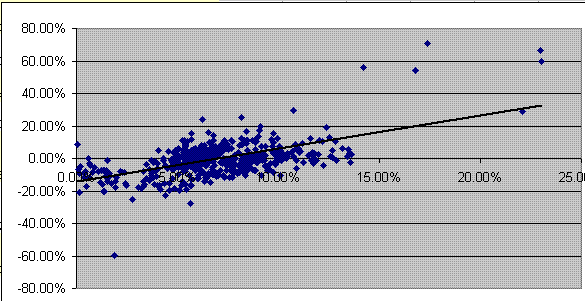
Moreover if I look at the retail investor instruments such as Closed End Funds (CEF), I find huge premiums for high distribution CEFs. High yielding CEF are trading at large premiums, sometimes reaching 40 and 50%. I put the premium along with distribution yield and got the chart below. It shows a clear relationship between yield and the premium. Investors are bidding up funds with large yields.

Actually anything with yields have rallied. The Wallstreet Journal has a story about investor appetite for Master Limited Partnership (MLP) for their out-sized yield.

I usually will bet with those buying government bonds. Government bond market is the largest and the most sophisticated in any asset class. Usually the message sent by the government yield trumps all other. However it may be different this time.

The Globe & Mail reports” ...the government bond market has been flooded by retail investors seeking what they consider a safer harbour than stocks for their investment dollars. U.S. bond funds have posted net inflows for 72 of the past 73 weeks. according to data compiled by EPFR Global of Cambridge, Mass. The bulk of that money has been earmarked for government issues, including municipal debt.”

The rally in US treasuries are perplexing given the fiscal and monetary policies of the US. Spending and loose monetary policies over extended period of time should push yields higher. The US treasury is indicating that there are no policy issues to worry about, while clearly there are many structural issues that should push yields higher, not limited to:
  • Social Security obligations
  • Health care obligations
  • Public Pension future obligation
  • State and municipal deficits and debt
The article brings an interesting conclusion: “....Baby boomers have lived through two 50 per cent market crashes and they are just leaving [equities]” in the mistaken belief they can do better in bonds.”

June 8, 2010

Opportunity in oil spill

There has been a lot of talk of the opportunity in the energy sector as a result in the sell off of the Gulf of Mexico (GOM) producers, drillers, platform operators...etc. Most of these names have been halved in price; BP is offering 10% dividend yield, which is an amazing return by itself.

The question presenting itself, is the disaster an opportunity for stock pickers? Some think it is.

The disaster is a game changer. No one can argue that in a couple of years, and into the distant future, GOM operators will operate in the same manner as they did few years back. I do not think so. Costs are going to go up materially.

Insurance, security bonds, royalties, clean up funds, taxes...etc will be on the rise as a result of this disaster. Some suggest that platform operators like SeaHawk (HAWK), which I reviewed their spin-off and did not like, is a good value proposition as it is selling below liquidating value. However it was selling below liquidation value a year ago as well.

I think the smaller the player the more disadvantaged operationally and financially in the new and expected environment. Weak balance sheets will find it harder probably to comply with bond and clean up funds requirements and will be forced out by the bigger players, who ironically caused the disaster in the first place.

If I wanted to buy, I like McDermott International (MDR), which will spin off it is off-shore construction and management business. The company operates three businesses:
  • off shore drilling project management,
  • government operation: nuclear submarine building, and
  • fossil fuel power construction

MDR will operate the off shore construction business and the spin-off will own the other two.

My idea is to buy on the spin off date MDR as it will be more than likely added to the several energy sector ETF and mutual funds. Those funds did not own it due to the complexities of the other two units and was not pure play energy equity.
  1. MDR will be less complicated than the other unit from accounting, regulation and business is easier to understand,
  2. growth potential in offshore drilling around the world; its Arabian Gulf operations is growing at a fast clip and will offset any weakness from GOM operations,
  3. demand from energy index and sector ETFs as the company will become pure play energy service company. MDR is held in mid cap portfolios but not in sector specific ETF like energy funds; ishares Energy Service, Holders (OIH)...etc. Will the spinoff induce sector specific funds to buy the oil and gas segment to be part of energy ETF/ funds? A very high possibility.
  4. The backlog of the company alone should provide good support for earnings growth.


To capitalize on the energy sell off, I will require more odds in my favour and I think MDR might do it.

May 11, 2010

CF Industries : The Perils of overpaying


I have detailed my thoughts on the Fertilizer buyout dance and how CF in its bid to stay independent overpaid. I expected the market to punish the company but the dramatic decline of CF stock exceeded my expectation. True the whole Ag space is under pressure but CF is down more than 30% compared to AGU, 12%.

This was easy short. Most of the time mergers destroy value but to overpay in such reckless fashion is a whole other story.

May 10, 2010

Value Idea: CCE implied spin off

A kind of a spin off in the works as a result of the buyout of Coke (KO) of it North American bottlers. The result of the transaction will be an independent bottler in Europe as KO will buy the NA division of CCE.

The transaction is very interesting. One thing is the transaction is not done growth. KO is buying NA bottling operation actually to limit competition in its distribution channel. The NA market is very mature and the competition is killing pricing and profitability in the system. That is why Pepsi and Coke have forked out billion to re-consolidate their own companies again. So the company being left behind is left alone not for economic issues. Actually CCE Europe is the better growth story of the two divisions.

CCE Europe or the New CCE is achieving 3% volume growth while NA coke case growth is experiencing a permanent decline. Profit growth and revenues are telling the same story. Europe is growing while NA is flat-lining at best.

So what is the valuation here?


  1. KO paid 8.4 multiple ( Entp value/ EBITDA) for NA operations
  2. the market is valuing CCE (Europe and NA) at 7.43 multiple
  3. that leaves Europe, after some backward deduction, at 6.02 multiple, that is way to cheap. Bottlers overall has an average 8.7 multiple, while other European bottlers have 9 multiple.
  4. doing some complex math the implied price per share of the new CCE will be $13.33, after $10 divined at the close of the transaction. The market may trade at $15, current price less the special dividend.
  5. If we apply peers multiples then the new CCE value is ~$19 per share. Not enough margin of safety for me at this point ( if you buy at now $26, get $10 dividends and be left with $14 to15 worth in new CCE shares, about 27% upside potential to full valuation).
However if CCE follows a typical spinoff behaviour then it might get sold off at the close of the transaction and then it may be a good value. CCE will be 100% European and it may get taken out of the S&P500 ( management “expects” to stay in the index) conditions to have fund managers dump the stock.

So at this point it is on the radar screen to see the development and price action at the close, which is expected to happen in the 4th quarter of 2010.

April 8, 2010

The Value of Corporate Events

I started to realize that hunting for value is a strategy well suited for, mostly, undervalued markets. Generally these situations appear abundant in these markets, therefore increases the odds of positive performance. However, searching for undervalued companies ala Buffett in markets that seemed to be fairly valued is not a strategy I am willing to undertake. I reckon undervalued markets like the one we had in 2008 is like shooting fish in a barrel but otherwise you need to be really a sharpshooter with strong set of skills or a lot of luck to do well.

Off course the obvious alternative is to stay on the sidelines waiting for those undervalued markets, but what if they do not materialize.

successful value investing requires significant diligence. Investing is not hard or rocket science but requires a lot of time and resources to come up with single idea. I reckon, based on my limited experience, to produce a single good idea you have to vet at least 10 with the same intensity and diligence. One of the most critical aspect of investing is generating ideas. Idea generation can't be random it has to be systematic otherwise you will never know what works. It is the pane of my investing existence is how to find those ideas? how to build a pipeline of company to analyse? do you start with A's and work down the alphabet? or do you run screens that will uncover good companies in the past? So needless to say it is important to have a "search technology", as Prof. Greenwald puts it in his book "Value Investing: from Graham to Buffett and beyond".

That is why event driven strategies is what I observed to be the best search strategy for individual investors. It is all about odds. Event driven investing puts the odds slightly in my favour. I get a concrete set of ideas with good probability of out performance. I have been concentrating on two events:
  1. Spin-offs,
  2. Post bankruptcy equity, and
  3. Index Deletion.
For example, spin-offs offer great hunting ground. I do not use spin-offs investing as a blanket approach, although I wish I did I would be better off for it. I need to vet the presence of good business and competitive advantage. Spin-offs will have duds, that's why they are being spun off. However, the odds to pick good performers over the next 3 years are much better than picking from the entire market universe. Most of the time markets fear from the uncertainty of smaller and unproven companies are wildly exaggerated.

From the spin-offs I followed, I have invested in some but not all, it out performed the S&P by 23%. That is not unusual. Most studies find 15-20% out performance for spun off companies. The reasons for the out performance vary from better focus to better information transparency.

There is a busy calender for spin-offs this year, I will post if any seem interesting.

March 23, 2010

CF/ TRA Merger- some thoughts

Here are some thoughts on the drama that played over the last year in the fertilizer industry. Please note that these are thoughts and I am researching to what can be an investable idea.

Takeover Frenzy:
The year long dance between Terra, Agrium, Yara, and CF Industries came to an end. CF won the bidding for TRA and took it away from Yara and in the same breath fended Agrium advances.
  • The acquisition of TRA is mostly a mechanism to fend off AGU hostile takeover. To defend against this unwanted advance CF overpaid. As Yara offered to buy TRA from underneath CF and CF struggling to find a white knight instead of Terra reaping a premium offer. In this vein, at least one person pointed out that once Yara did a deal with Terra, CF lost its white knight. CF was left facing a low bid by Agrium and its bidding here made sense in order to prevent a deal with Agrium for a low price forced by CF’s own coming election.
  • The TRA acquisition is not a tuck in acquisition but almost a merger of equal. CF and TRA are of similar size in terms of market cap and Ent value. TRA had $1.5 B in sales as of 2009, $2.5b in 2008 while CF had $2.6B as of 2009.
  • CF might got caught in a bidding frenzy for Terra that lead it to over bid for Terra. the increase in offers are as follow:
    1. March 10, 2010 final and winning offer: $47 or $4.6 market cap. 37.15 in cash and the balance in CF shares
    2. Dec 15, 2009 third offer: 45.91
    3. Nov 1, 2009, second offer : $40.50
    4. Jan 15, 2009 initial offer : $20.98 or $2.1 in market cap this was an all stock offer
  • The peculiar thing is CF used its shares as a currency when it was beaten down in January 2009, however used an almost all cash offer in its winning offer in 2010 after its shares have a considerable run and traded at 52 week high. Why would the company uses its shares when it was trading at what it seems a large discount to intrinsic value while uses cash when the shares have recovered.
  • Another peculiar aspect is CF has proclaimed that AGU offer undervalues the company but it was happy to use its own undervalued shares as a currency for takeover of TRA.
  • The length of the merger process might have increased the mental investment and cost to CF executives making it harder to forgo those costs and walk away. although these costs should be considered sunk costs and not factor in making and acquisition in March 2010. Maybe it became win at all costs. I am not sure what changed in the span of 12 months to justify more than 100% increase in value paid to Terra.
  • The merger announcement talked about being".. the largest nitrogen producer in the world among publicly traded companies as measured by production capacity". May be CF wants to the biggest and baddest at the exp of shareholders.

Over Paying
CF simply overbid for TRA to escape being bought by Agrium. Please consider:
  • CF offer values Terra at $47 per share. The offer represents:
    • 2.9 x sales (TRA highest achieved 2.2x at that market top in 2007)
    • 9.5x book value
    • 30.5 x earnings (highest achieved 25x in 2007)
    • 22.7 x Cash Flow
    • CF overpaid for the company as the DCF value of TRA as a stand alone company, assuming 10% growth rate for 10 yrs and 5% terminal rate for Cash Flow of $3.19 per share, is $41.68.
  • CF claims that it paid 8x TRA's EBITDA (see merger presentation footnotes). That claim is more spin than reality for several reasons:
    • CF averaged 3 years to get the EBITDA of 622 while 2009's is mere 402
    • 2008 was an abnormal year for Ag where prices have shot up for Fertilizers and ag in general. CF includes 2008 to average out to 622 in EBITDA. TRA never approached that level in EBTDA or came close. would that be repeated again? so to include a record year in your EBITDA will increase average and lower the multiple to make the transaction more salable to shareholders, which by the way are precluded from voting on the transaction thank to CF management to not be bogged down with a limitation in their pursuit of TRA.
    • CF claims "~$1.54Bn of combined EBITDA (including run-rate synergies): Based on 2010 CF management EBITDA guidance, excluding minority interests, of $752MM for CF (see non-GAAP reconciliation on p.6), plus $655MM of 2010 EBITDA per Terra (refer to Footnote 1 on prior page), plus $135MM of run-rate synergies" However, CF used its guidance for 2010 and the 3 year historical average for TRA to arrive at that number. Talk about apples and oranges.
    • "I believe a $100/st nitrogen production margin ($3/MMBtu natural gas for 1 metric ton ammonia production in Yara's thinking) is as good as it will get going forward, and based on this, $600 million is the high water mark for earnings from this asset set. This is based on 6.5 million tons of annual nitrogen production, less SG&A. Terra's EBITDA hit $964 million in 2008, which was an extraordinary year for the company. "
  • CF will pay about 6 percent of its entire market capitalization in fees. On a per share basis, I calculate this to be about $5.75 per CF share. This does not include the $123 million termination fee that CF is paying to Yara on Terra’s behalf as a result of TRA terminating with their merger agreement to accept CF's offer.
  • CF will issue equity to fund TRA acquisition, lots of it; it can be dilutive. The company will issue $2 Billion worth of shares: $1B for TRA shareholders and another to the public. Total issuance represents 30% of current and new shares based on today's market price.
  • TRA UK assets are declining due to pound devaluation
  • valuation of integrated companies:
  • what kind of return can CF garner on the acquisition? I reckon no more than 15% in ROIC, this is the best case scenario. The ROIC figure is covering assumed cot of capital of 12%, however, I have my doubts about their EBITDA and synergies claim as detailed here. If I start calculating more accurate ROIC figures using accurate EBITDA like better cycle than just 3 yrs and including an average of non recurring charges...etc I sure they do not earn their cost of capital.
  • The invested capital is the cost of the acquisition which are:
    1. offer: $4.6 Billion
    2. termination fee to Yara: $123 million
    3. bankers fee incurred by CF: $270 million
    4. Grand total : ~ $5 Billion
  • What is the return CF is going to get:
    1. $622 (based on the 3 year average EBITDA of TRA)
    2. $135 million in synergies

Perils of Integration
  • Do CF have merger integration experience? CF did not make a large acquisition like this and was not a serial acquirer of smaller operations so that begs the question how will they integrate?
  • I want to handicap CF management so lets look at their track record by calculating ROIC.
  • CF has capacity to add debt as it has lower leverage . It will add $4.05 billion in financing to its balance sheet to complete the acquisition.
    • what does the combined company look like?
    • CF claims "flexible balance sheet with ~$1.7Bn of Net Debt by the end of 2010 (Based on CF management expectation of $2,034MM of debt less $321MM of cash (excluding $134MM of auction-rate securities)"
  • CF claims that there is $135 million in annual synergies ( those synergies were $100 million at the time of the initial offer) from the elimination of:
    • duplicate corporate functions: it should be very little if any to be considered material and worthy of synergy.
    • optimization of transportation/ distribution : need to look closer at this claim
    • greater economies of scale in purchasing and procurement: but 50% of their production cost is natural gas and the commodity is not driven by volume but rather by proximity to distribution network or closeness to production hubs. However natural gas is cheap at the moment given them larger margins and NG is expected to be low priced for the foreseeable future. Nevertheless it is an advantage that can be enjoyed by the entire industry rather from economies of scale as a result of the merger.
  • It is hard to see exactly where CF is going to get the extra $75 million in synergies they asset they can deliver, over and above the $60 million that Yara said it can achieve, the latter being more evident.
  • distribution channels are different since Terra's customer base is industrial and CF's is agricultural

February 28, 2010

BPO Properties REIT Conversion

BPO Properties, a public subsidiary of Brookfield Properties at 89%, will convert to a Reit in April 2010. The transaction does not really change the economics of Brookfield, however its implications are more subtle. Please note that I own Brookfield Properties.

  1. Brookfield Properties will follow the same game plan of Brookfield Asset Management (BAM), its parent, by creating ownership structures floating them and earning management fees from them. Not only Brookfield Properties will de-leverage its balance sheet, which it badly need, but will establish high Return on equity revenue stream.
  2. BPO Reits will be sold to less than 50% by Brookfield in the future as Brookfield will not want to consolidate debt of the Reit. Also conversion to a Reit mostly will benefit retail investors rather than corporate subsidiaries, as dividend income flows between corporation tax free.
Given that I am not sure why BPO Properties shot up 10% on the announcement? There will be more supply of BPO shares in the future and higher cost structure given all the fees the Brookfield Properties will earn from them.


January 16, 2010

A Bid for Illiquidity


Back in November 2008 to January 2009 buying decisions were fairly easy. There was all kinds of opportunities to choose from. All you had to do was step up to the plate in any asset class or in any market and take a pitch. Right now buying any asset is not so easy. Credit and equities are fairly valued. I have not find anything of interest. I spoke about few ideas but nothing interesting materialized.

To find a good pitch I have to find a market where the level of professional analysis is a bit lower. So I will have to avoid the US markets. That means I have to find illiquid assets. That is fine by me. Liquidity is not worth a cent in my book. So I found the Canadian Debentures. Those are subordinated and unsecured, in some cases, debt instruments issued by companies of lower credit quality. I have sifted through dozens of these names and I have found two ideas. I tried to establish a position in both but I was unsuccessful and the price ran to the point it is no longer attractive to me, and that is why I am writing about them now.

Royal Host 2013 6.25% Debenture (RYL.DB.C)
Royal Host is a hotel owner and operator in Canada. It owns and operates economy hotels mainly in Ontario and Western Canada. I do not need to go into the hotel industry fundamentals as they are atrocious right now. It is worth noting that hotels performance is tied closely to the economy. But this is not a bet on the economy, it is a wager that I will get paid in 2013 at 100 cents on the dollar while purchasing the debenture at 68 cents on the dollar.

I have been stalking this issue for awhile but the price ran from me from $68 to $80 at the close Friday. I am no longer interested at that price but if it dips down I will try again. What makes it worthy? The issue is distressed debt in the hotel industry, where debt is selling at 68 cents on the dollar. If hotel vacancy and rent per room are stable at current level which is bottom of the cycle then debt is over collateralized at cap rate up to 11.5%, extremely low valuation even in the hotel industry. The Company have several liquidity generation abilities and should fund its obligation and debt maturities with no issues. The debenture offers the potential to generate IRR of 27%.

If you bought the issue at 68, the company will have no problem repaying you at 100 cents on the dollar even if cash flow from operations after debt service is negative, according to my analysis and valuation. The company have several options to generate funds:mortgage assets that are free and clearsell a sizable marketable securities portfoliocut its dividends
The only issue here is the company stock buybacks. The company is using its available funds and selling its portfolio to buy back its shares. It had tendered for 26% of its shares in December and going back for more in Jan 2010. Why is the company doing this while it cash flow from operation can barely service its debt. The answer is it may be setting up for going private transaction.

The company is 25% owned by Clarke Inc and its board are mostly controlled by Clarke. After the tender Clarke ownership will jump to 37% and potentially more after the additional tender offers by the company. Clarke obviously wants to take private Royal Host with little cash outlay on its part, particularly that Clarke's balance sheet is in worse condition than Royal Host. If the privatization takes place sooner than maturity the debentures will be redeemed at 101 cents on the dollar. However if the tenders keep coming it will compromise the collateralizing of the debt.

Still at high 60s or low 70s I think the issue is worth the risk. But now I will bite my time until either it comes down in price or look back and see how pretty my spreadsheets look like.

Next post I will tackle the second idea.


December 22, 2009

Pacer: Change of Mind

Pacer is in the right space; the intermodal space that is. However it might not be the right investment. There is good likelihood of business failure and permanent loss of capital. I have sold out of it earlier and took a 3% gain from my cost basis.

Why I do not think it is suitable for an investment because of several factors:
  1. The company lost its wholesale business to HUB Group, as Union Pacific (UNP) renegotiated their long term contract, which gave Pacer a competitive advantage for a long time.
  2. Now Pacer does not have any pricing power or unique access to the UNP network so its advantage have disappeared.
  3. Pacer will try to establish it new business going to shippers rather than selling to other logistics businesses, which is unproven field for it. If management had showed better skills and better Return on Capital over the last 5 years, even with unique advantage it failed, I may have given it the benefit of the doubt. But there are no indications of superior skill.
  4. Management have to win business and that will be a tall order its revenue growth over the last 7 years, the go go years of global trade, have been -5%.
  5. Pacer with no trucking assets can get its margin really squeezed by truckers to complete the various legs of the intermodal trip. However most of its competitors either have their own trucking or have a larger under contract owner operator. This will decrease Pacer flexibility and attractiveness for customer needs.
  6. Recent liquidity issues and reduced credit facilities can turn off customers from giving their business. Supply chain managers and shippers priority will always be reliability rather than price.
  7. Pacer would not see any positive cash flow from operations for next year according to my model which will continue to raise solvency issues as it did this year.
  8. CEO abruptly retired. The company felt the need to issue a press release to recently to emphasize that all was preplanned. That was very defensive move that leads to believe that there are something more o this issue.
  9. A lot of insider selling. Not a good sign.
  10. the new credit facilities the company negotiated limits capex at $6.5 million per year going forward. The company used to average $9.5 million per year and most of it is maintenance capex. Without investment in the business it could lead to deterioration in operations.
  11. Also the credit facility is very strict and keeps Pacer on a tight leach.
  12. If I assume mid cycle revenue level of $1680 and loss of $550 due to the new agreement with UP that will leave Pacer with revenue level of $1130. Further if I assume the average EBIT margin over the last 4 years that will give me an EBIT level of $19 million. However the new cost structure of Pacer due to its agreement with UP and loss of business will be higher so lets assume 1% margin, which will leave us with EBIT of $11.3 million. This translate Pacer Earning Power Value is $113 to $160. This does not factor capex, taxes or interest, so very much where the market is trading right now. Not an appealing valuation.

The shorts are having a big field day with this; it is been shorted heavily with a good reason. Management need big effort to turn around, cost cutting can do only so much.

December 17, 2009

Lear: Post bankruptcy Equity

This is a very interesting idea. Lear (LEA) has just emerged from bankruptcy that it entered early in summer of 2009. The bankruptcy was voluntary.

Lear is a supplier of car seating and some electronics to car makers. Lear has a very dominant position in the seating market. However GM and Ford makes the bulk of its sales. In fact GM makes 23% of its sales while ford makes up 19%. Management is focused on diversifying this mix. They are focusing on sales into Asian countries where sales growth did not skip a beat in the last 2 years, unlike European and North American which sales plummeted.

What is good about the company is the following:
  1. Bankruptcy. Although it sounds bad but Lear has shed a lot of debt that was kept on its balance sheet after sales of some units to Wilbur Ross.
  2. Management owns a lot of stock. In fact management owns 2.4% of shares on fully diluted basis upon exit from Ch. 11 and the CEO has a big chunk of it. I think management will do whatever it takes to increase business value.
  3. There will be a lot of forced selling and a lot of technical overhang that could pressure the stock in the next 12 months. the selling pressure will be from:
    1. CLO funds. Lear debt and loans was wildly held by CLOs. CLOs do not hold equity; their charter do not allow it.
    2. Preferred stock conversion. Right now preferred are in the money and the company can force its conversion.
    3. Warrants exercise also in the money.
    4. Warrants and preferreds conversion will cause 35% dilution.
  4. The quick exist from bankruptcy limits lawyers and advisers fees.

What is not good about the ideas:
  1. The auto market has a lot of capacity still. even after all the bankruptcies not a single car maker disappeared, well only one Saturn but Saturn is made by GM so capacity is still there. We need to see some liquidation in the space.
  2. Margins are very thin right now below historical norm. This may change with more sales.
  3. GM and Ford make the bulk of its sales. Enough said.
  4. Economic risks of decline as so far recovery is shaky.
  5. Valuation is not cheap enough. I figure a good entry is between $48 and the high estimate of $55. If I am right about the selling overhang it will get there within a year, although it does not look like it as the stock price is on a tear lately.

December 3, 2009

What is wrong with this picture?

Natural gas producers have rallied and continue to do so although the underlying commodity is suffering. Natural gas producers represented by index for natural gas producers have returned some 45% on YTD basis while the underlying commodity has declined by 62% on YTD basis.

Normally that relationship have a high correlation. Natural gas producers price returns go the way of the commodity. However the relationship seem to have been broken since March of this year.

Is buying in this market indiscriminate? May be, but this is a question that can not be answered with full certainty. You can only attempt to guess as one would never have complete information to ascertain the validity of a claim.

December 1, 2009

Cloud Peak Energy...not so Peak Value

Rio Tinto IPO of Cloud Peak Energy (CLD), sort of a spin off, came with no great fan fare. The IPO has gone down some 10% so far. There are good reasons why the stock is down. Some are due to industry dynamics and other, in my opinion, is due to the corporate structure of the mines.

Industry Dynamic
Demand
Coal demand is growing. There is no secret that coal is under pressure from environmentalists and regulators due to global warming issues. CLD mines thermal coal used by utilities for electricity generation. The US generated 50% of its electricity from coal. So there is no escaping coal no matter what politicians say or do. Coal will be still be used during my lifetime and even during my sons lifetime. Coal demand will grow as long as we use electricity.

Supply
There is a glut of supply right now evident by increasing stock piles at utilities, but I reckon that will be short lived:

  • Miners are cutting coal production in 2010 due to decrease in demand that will stabilize pricing
  • Mountain top mining in the states is in jeopardy as a source of cheap thermal coal due to environmental issues.
  • Mountaintop mining in West Virginia, Kentucky, Virginia, Tennessee and parts of Pennsylvania and Ohio accounts for 6 percent of U.S. coal production.
  • The end of mountaintop mining in Appalachia would remove about 70 million tons a year from the market, increasing demand for coal from Colorado, Montana and Wyoming.
  • EPA has been holding mining permits with more frequency under new president.Natural gas pricing, is it firms up then utilities that switched to nat gas will switch back to the cheaper fuel, coal.
On balance the downturn in coal is cyclical rather than permanent. So when a distressed seller like Rio Tinto, it needs cash to repair it over leveraged balance sheet, off load its coal business at these levels, it piqued my interest.

Transaction Specific Issues

My issue is with how the split off is structured. There are many issues that makes me hesitate pursuing this business.
  • Rio Tinto still owns some 49% of the mines. However its ownership is at the limited partnership level rather than the holding company CLD. The public owns 100% of the holding company which in turn owns 51% of the limited partnership. That will make for conflict of interest between the public holders of CLD and Rio.
  • Pretty much CLD is controlled by Rio as its board of directors is made of RIO executives. Moreover, CLD is governed by agreements that needs Rio's consent.
  • Funds from operation will go to Rio and the holding company, CLD, but not to shareholders. I would rather see RIO and the public holders get the same treatment makes for better alignment of interest.
  • Tax reimbursement agreement where CLD pays Rio any tax savings due to higher assets base level making depreciation and amortization higher thereby reducing taxes on income.
  • Debt that got loaded onto CLD'd balance sheet to pay Rio for the assets is a bit high and will saddle the CLD with interest payments for some time to come.Most of the proceeds of the IPO goes to Rio.
So as you can see the deck is stacked in favour of Rio at the expense of CLD holders. However, there are some good qualities for CLD being low cost producer, cheap, and good reserves.

In conclusion, I will wait for a better entry point or when Rio floats the reset of its ownership in these mines.

November 14, 2009

Liquidity made me do it

The rationale for the market rally since March 09 has been liquidity pumped by the Fed. The interesting point is that the market decline from summer 2008 to March 2009 has been also explained by the disappearance of liquidity. The disappearance of liquidity was caused by over levered banks.

I am not going to agree or disagree about the causes of the market rally because I can't. I distinguish between causation and correlation. The latter is easy to detect by statistical methods, however the former is almost impossible to prove. So arguing that point is irrelevant. One suffice to note is liquidity can disappear overnight but can't appear in same speed. It takes time.

Most investors, as evident by the decline and rally of the market, value liquidity. They attach a premium to it making liquid assets somewhat expensive to illiquid ones. I am agnostic to liquidity therefore I am not willing to bid more for it. However price is more important. I was a willing buyer from October till May, although in retrospect, regrettably, not enough. Now I am not. Back then the cyclically adjusted PE was around 10, now it is 19, above the long term average of 17. See chart courtesy of Dr. Robert Schiller.
At these levels I am more risk averse. I have sold several positions over the past few weeks for a summary see here and here. I have also wrote calls in American Express (AXP) at $40 which should take out of that position by it expiration next week. Moreover, Burlington BNI have been taken over by Berkshire which should close by early next year. So my cash position is rising so what to do.

In an fair valued or overvalued market I concentrate exclusively on event driven positions, like takeovers, spinoffs, bankruptcies and reorganization and liquidations. My favorite is spin-offs. Some of the opportunities I am looking at:
  • AOL spinoff from Time Warner
  • Madison Square Garden (MSG) spinoff from Cablevision
  • Cloud Peak Energy coal spinoff from metals giant Rio Tinto
  • Pharmaceutical Product Development, Inc. (PPDI) Spinoff of Compound Partnering Business.
  • SixFlags post bankruptcy equity
  • Lear Corp post bankruptcy equity
In an over valued market where you look can be different than an undervalued one, where businesses sell far below their normal earning power value.

November 10, 2009

Exit from Peyto

I sold out of Peyto Energy @ $12.26 (35% return) due to changes in competitive structure of gas supply. Pipelines are raising significantly their fees to carry natural gas. This will spell increased operating costs for gas producers and will lower asset values.

Demand for natural gas occurs in the north eastern of this continent and supply, typically, comes from western provinces like Alberta. So transportation costs is big chunk. TransCanada pipeline will raise fees by some 50% next year, which will make western Canada gas uncompetitive compared to closer sources. In the past there was not many sources close to the northeastern market but now they are abundant. There is two new sources that can supply that market maybe at lower costs with transportation costs are rising signifiacntly:
  1. New shale gas basins that are coming online are much closer to northeastern states like natural gas from the mega Marcellus shale play that extends to west virginia, is likely to grow to 1.0 Bcf/d.
  2. LNG gas coming from overseas as Europe does not need as much gas as previous years due to economic slow down.
The reduced operating profits at gas producers as Peyto will lead to lower credit as bankers set credit lines based on estimates of their NAV or reserves in the ground. Those estimates are facing a double whammy: lower gas prices and higher operating costs. Many will see their credit lines reduces in March 2010 and will scramble for liquidity.

I will come back to Peyto as it is my favourite in the space once something changes in the fundamentals.

November 7, 2009

BNI buyout by Berkshire


Berkshire acquired BNI earlier in the week for $100 consideration. I will not detail the offer as most media have done it with better detail. However the post is about my view and my future action.

First my view on the transaction. I am really disappointed that BNI is going private, you can read my posts on the company here. I had visions 10 years down the road to see my investment in BNI to have risen by 1000% or more, so to be deprived from such investment, to say the least, is disappointing, albeit my return from holding BNI is 50% plus dividends, so I am always thankful.

The price is low relative to the value of BNI. BNI has tremendous land holdings that are not realized in its balance sheet. Also, BNI is not just a good business with competitive advantage, it is a protection against inflation and oil prices. BNI does well when oil is high or low. When oil is high their rates go up in lock step however if oil prices are declining so is their costs. BNI also is a good hedge against inflation as it rates and assets can compensate investors for rise in prices.

Second, I will opt to take the cash. I do not understand Berkshire and Buffett is not going to last forever. To preempt any comments, I did not say Berkshire is bad business but it is too complicated for me, that is all.

Thrid, I will tender my shares for cash rather than sell due to several factors:
  1. I want to postpone my capital gains till next year,
  2. in the unlikely event the acquisition fails,
  3. I am not leaving $3 on the table, and
  4. There is a dividend payout coming up before closing that I want.
Fourth, BNI represented more than 10% of my portfolio so I will have a lot of cash coming back to me to reinvest and that creates some problems. First, the market is at fair value which makes finding ideas a bit difficult. Moreover, the risk in this market is to the downside currently. Second, most railroads have shot up on the acquisition so replacing BNI with another will be difficult as a lot of people are emulating Buffett and bidding their prices. I do not like crowded trades. But I will follow some railroads to take advantage of any weakness. Two of my favorites are Canadian National (CNR) and Union Pacific (UNP). I am also looking at Canadian Pacific, where it could see some improvements in margins with better management. Third, good ideas like BNI are rare.

The other alternative is to invest in Intermodal companies. Those companies use multi modes of transportation on behalf of shippers to get goods to their destination. Intermodals obviously need access to the rail networks through agreements with railroads. Some Intermodal companies own a fleet of trucks to handle what is called last mile transport or the final link from rail to the buyer, or can contract this out to independent truckers.

Pacer International (PACR) is
...asset-light North American logistics provider. The Company provides transportation and logistics services to numerous Fortune 500 and multi-national companies. The Company provides its transportation services from two operating segments, its intermodal segment, which provides intermodal transportation services principally to transportation intermediaries, beneficial cargo owners and international shipping companies who utilize intermodal transportation, and its logistics segment, which provides truck brokerage, truck transport, supply chain management services, freight forwarding, ocean shipping and warehousing and distribution services to a range of end user customers.
Pacer had a bad run lately as its contract extension with Union Pacific, where the majority of its freight revenue come from, was uncertain and weighted on the stock heavily. I liked that situation. I bought at $3.16 last week to take advantage of investors flight due to uncertainty. Although the stock has shot up some 50% since their earnings and contract renewal two days ago, I think the potential to move to $8-10 per share is reasonable.

I admit I did not finish buying to establish my desired position and rather to have bought before the move but the risk/ reward thesis is still valid. The stock should drift higher as investor buy again into it after the uncertainty has been removed.

I will share more thoughts on Pacer some other time.

October 9, 2009

IFRS implementation in Brookfield Properties

Brookfield Properties (BPO) will adopt IFRS, new accounting standards that most US and Canadian companies will transition into, ahead of schedule according to their press release. You will see most real estate operators opt to adopt IFRS early, particularly those with properties acquired more than 5 years ago. That is because it will decrease their leverage and increase book value.

IFRS allows companies to adopt fair value measures of their assets. It is advantageous for owners with older properties to account under IFRS this way their leverage ratio will be much better. Also I think in this cycle where commercial real estate have been clobbered you will see many years in the future of up revaluation of properties and steady increase in book values.

The accounting changes will move BPO book value from $9 to about $14 making Price/ book value less than 1.

Also they will be compare more favorably now that leverage is reduced. Most analyst do not like BPO because it has higher leverage ratios compared to other office owners.

October 4, 2009

Practice Investing

Investing is just like any other discipline you need practice to develop the skills to be good at it. For awhile I have been thinking about a framework of skills and how do I practice to improve my game. I have broken it down to three elements that need to be developed and worked at constantly:
  1. Knowledge
  2. Skills
  3. Behaviour

Knowledge:
If you have read Poor Charlie's Almanac, which I recommend highly, you will see that he harps on what he calls "mental models". This is the equivalent to knowledge in my framework. However, I want to further detail these models into two elements:
  1. Systems Knowledge: similar to Munger's description, it is your knowledge of the necessary sciences to enable you to decipher your way through events, readings and decisions:
    • Accounting
    • Mathematics
    • Psychology
    • Language
  2. Domain Knowledge: Munger did not explicitly break out this element as a distinct "mental model" but he emphasized reading a lot. Domain knowledge is the structure of information and data or "insights" about a specific industry. You can't be knowledgeable sufficiently about several domains so you have to keep your efforts focused on few ones, the less the better investor you will be.
How do you practice your knowledge building capacity? By writing down notes about what you read. What you need to write is not a summary of the information but an answer to the questions: so what? What will be the impact of the news item on you, your business and the companies involved?

Skills
To develop the knowledge required, you will need to read and read a lot, this has to be evident by now. Here are the skills that you need to work at as well to be more effective and efficient:
  1. Speed reading: you need to read quickly because knowledge has one limitation and that is time. The skill is hard but you need to work at it to continuously improve the yield on your time by acquiring more knowledge for each unit of time spent.
  2. Memory: what is the point of reading if you can't remember the information you need to analyze a particular situation or identify a unique opportunity. This is a skill that can be improved by practice as well.
  3. Creativity: Munger in his book said to "invert, always invert" well to do so you need imagination. Creativity is needed in order to develop future scenarios and imagine possible risk for business.

Behaviour
I have identified three behaviours or personality characteristics that need to be nurtured as well:
  1. Passion: your passion should be about the process not the outcome. If you are passionate about the process you will think and have perspective on how to improve it rather than use it in a mechanical fashion.
  2. Adaptation: one of the most valuable traits of humans is their ability to adapt to their circumstances and learn from their mistakes. But this require that you take responsibility and internalize errors and mistakes rather than blaming it on chance or others.
  3. Determination: because you will fail but you need a combination of strong will, ambition, and discipline to keep going as what I outlined here is a lot of hard work.

Train hard!!!!