Showing posts with label BAM. Show all posts

September 22, 2010

When the Risk/ Reward Proposition Changes

Price is what makes an investment attractive or not. Price changes the risk reward proposition of any business even good ones. As such there is few issues that have to exist my portfolio: Dr. Pepper and some credit instruments.

I am going to sell some of the preferred issues that I bought during 2008 and early 2009. The risk reward proposition has changed significantly. I have discussed how investors are becoming yield pigs and I want to exist before the party is over. The low yield environment is forcing some instruments to trade higher artificially. Some of the credit issues like junk bonds, bank loans and preferred shares made sense in late 2008 and early 2009 but now it is

Here is an example of an issue I bought in November 2008, Brookfield Asset Management (BAM) issue BAM-O. I have bought additional issues from Brookfield as well like a yield floater, detailed here. The O issue gave me an IRR of 36% when I bought it, now it is yielding 2.5% to 6%, depending on the redemption or conversion of the issue. This issue trades at fair value now, if you consider the IRR to be the equivalent of YTM, then a BBB issuer like BAM is trading around the 6% mark. if I hold to maturity the upside is an expected rate of return of 4%, the downside is significantly more than that. I would never buy this issue now given its price so it is time to exist.

I am existing also most of my bonds positions however I am keeping a couple of floater preferred shares because they should do well in rising interest rate environment, given that there is no market surprise.

I sold Dr. Pepper (DPS ) as well for the same reason: risk reward profile changed. DPS is a spin off investment that was loathed by the market: too much debt, weak earnings and declining US carbonated volume sales. However, the reduced expectation and the strong brand portfolio made it a good investment. Now it is a good business but not a good investment. DPS has managed to drive efficiencies to its distribution and supply chain network, promote brands and gain market share, reduce debt and increase cash flows and dividends. The turnaround in operations made it a good business and share price followed. The risk reward profile changed. DPS is not fully valued at this point I reckon $40 is the mark but from where I sold it at $ 36 the upside potential is not significant to justify risk losing if they had a bad quarter.

December 29, 2008

Debt with Equities Like Returns


Debt seems to be a theme for me over this year. most of my purchases were in debt related instruments. I have invested in Commercial real estate debt, bank loans and the quasi debt preferred shares.

1. Purchase of bank loan Close-end-fund PHD at $6.75:

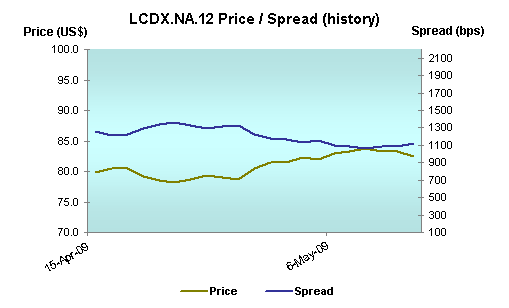
The Credit markets recovered over the few weeks particularly in the non government debt. Some of the funds that I was analyzing for investment in bank loans have moved up, some by 30%. The spread on bank loans have come down significantly from few days ago as displayed
in the chart.

There are a lot of improving signs in the credit environment:
  • LIBOR is came down and it should provide significant debt service relief
  • Mortgages are down to historic rates
  • Corporate yields are down indicating trust in corporate paper or at least some money is moving into that market.
  • even high yield rates have gone down.
  • all this is accomplished with treasuries at historic lows still, i.e. the spreads are still the same but yields have came down because people are buying and capital is flowing into the credit market rather than treasuries.

2. Commercial Real Estate Debt:
I have bought NorthStar Realty (NRF), maybe prematurely in hindsight but I still like it, to capitalize on the cheapness of commercial real estate debt.

From Bloomberg:
Top-rated commercial-mortgage bonds, which returned 32 percentage points less than Treasuries in October and November, have offered a record 12 percentage points more than government notes through Dec. 24, Barclays Capital index data show.

Debt markets are improving amid hopes that prices fell enough to account for potential defaults and as the U.S. government continues efforts to thaw credit and curb a yearlong recession. One of the AAA classes of a $7.6 billion 2007 Goldman Sachs Group Inc. commercial-mortgage-bond deal, considered a market benchmark, has jumped 24 percent, according to Ken Hackel, head of fixed-income strategy at RBS Greenwich Capital Markets.
I am considering to double down in the new year on the name; I am waiting for the possible dividend cut first. NRF will make it through this crises and will have high odds of making high returns:
  • The company has $326 million in cash while its market cap is about $250 million.
  • Its portfolio of loans are predominately prior to the 2005-2007 glut of weak underwriting and loose credit standards.
  • It has underwritten all of its loans so it has first hand knowledge of its economics.
  • Management owns 11% of the company so its interest is aligned with shareholders.
  • It has a large portfolio of health related commercial real estate which is doing strongly and values are going up.

3. Preferred Shares
I have accumulated preferred shares in Bombardier and Brookfield Asset Management to take advantage of price volatility versus the credit worthiness and strength of their balance sheets. I will add to both of these positions in the future.

I think debt have sold off more than equities and was offering equities like return with much better security in the event of default. Investors have raced to buy Treasuries for no return and it will not be long that they will seek better yields in the credit markets.

I have an equity purchase that I will make in the new year and I anticipate to be a big chunk of my portfolio. I have been studying the company for over six months and I have gotten a very comfortable feel of its competitive advantage and prospect.

Hope you have a happy new years!

November 29, 2008

Value Idea: BAM Preferred Shares

I have detailed my case for the Bookfiled Asset Management (BAM) preferred here. I will elaborate on some additional points on its investment merit.

I have picked BAM.pr.b issue, which has the following characteristics:

  • Floating rate issue, i.e., dividends change depending on the Canadian prime rate.
  • The issue is redeemable at BAM option at $25 per share, i.e., the issue has face value of $25.
  • Dividends are cumulative, i.e, if the BAM decides to skip a dividend payment then dividends would still owed to the investor.
BAM's preferreds offer me an excellent opportunity to earn great return that I could not simply pass up. I have bought BAM.PR.B at $7.9 per share to earn a dividend yield of 10.5% annually. There is room of capital appreciation as well. The face value of these preferreds are $25 per share; they are trading at almost 70% discount to where it was trading just a year ago. I do not think this price will be the absolute bottom but in the long run the odds are in my favour to earn
satisfactory returns.

Brookfield Asset Management (BAM) has four operating categories from which it generates cash flows:

  • Property: those are unique properties in supply constrained markets, mostly downtown properties in major urban centres, mostly through its ownership of Brookfield Properties (50%), another holding of mine, although it operates some properties on its own as well.
  • Power generation properties in demand stable markets like North east and west cost.
  • Infrastructure assets like transmission lines and timber fields.
  • Asset management for institutional entities. BAM uses these funds and co-invest with its clients in the above three categories. moreover it does manage security instruments as well.
BAM have great management talent, which its philosophy is to buy unique valuable assets at a fair price rather than average asset at a discounted price. See this presentation by their CEO to appreciate the value philosophy of this management team. Moreover, BAM has been creating value to its shareholders by spinning unique assets, like Brookfield Properties and Brookfield Infrastructure.

This is a bet not only on the assets earning power but on management to deliver value. I think betting on management was underrated in the investment discipline, where asset value and earning power was the focus.

Additional points of consideration:

  • Interest rate risk: these are floaters and their dividends payment correlate to prime interest rates, so the risk of more interest rate cuts will lower its payout. Retail investors mostly hold preferreds and their actions are mainly driven by fear, so these shares trade violently each day and sometimes their trading does not make much sense. At current prices investors are pricing them as if interest rates will never rise again. I betting that interest rates in few years will rise and will rise rapidly, in such case these preferreds will gain. However if they do not I am earning more than satisfactory returns.
  • You could buy fixed rate preferreds and you will do well but I would like to reduce interest rate risk from this issue and floaters are great way to do it.
  • Cash flow levels are solid: Currently BAM have about $3 billion of core liquidity and generate about $2 billion of cash annually. Moreover, FFO per share for the third quarter was US58¢, up from US51¢ in same quarter of the previous year. Excluding net gains and unpredictable items, BAM’s adjusted FFO available for common stockholders at US50¢ per share, up from US45¢ a year earlier. Adjusted FFO is funds from operations after the payment of all interest and expenses. It is not quite the equivalent of free cash flow, but a good indicator that BAM is a good generator of cash. BAM’s cash flows remain solid, while it’s financial position is strong an it is cash rich at a time when others face forced liquidations and cash is king.
  • BAM has maintained acceptable balance sheet ratios with just under 30% debt-to-total capital (book value) and cash flow-to-debt of 0.33. BAM’s coverage ratios also remained strong in 2007, with interest coverage on a remitted basis of 5.3 times and fixed charge coverage of 3.9 times.
  • Debt level: BAM Investment-grade financing strategy is to hold fixed rate, diversified and long-dated maturities. The strategy matches their assets and reduces any risk of funding miss match that could lead to asset fire sale or forced liquidation. Moreover significant chunk of BAM's debt is non recourse. This deb is associated with mortgages on their commercial properties. Why is this important? because no single property can take down the company if it ran into trouble.
  • In the event of balck swan bankruptcy, my capital hold a good probability to be protected. If we assume a 75% liquidation value of BAM long term assets there will be just enough funds to cover preferred holder and wipe out common equity holders. Off course preferred shares rank higher than common equity and should see full recovery of their book value; book value of all outstanding preferred is $870 million. And because we are buying those issues at deep discount we have almost 45% margin of safety.
Account
BV As of Q3 2008
Recovery values
Liquid assets- values will hold
13,370
13,370
Long term tangible assets
38,953
30,000
Less all liabilities
42,635
42,635
Surplus available for preferreds and common equity
9,688
735

I am not only like their preferreds but I like their business model and management. I am looking at their common valuation to determine if an investment in their common equity is warranted.

November 26, 2008

FT.com / Columnists / Martin Wolf - Why fairly valued stock markets are an opportunity

FT.com / Columnists / Martin Wolf - Why fairly valued stock markets are an opportunity:

Great article about the valuation of today's market. I have been using the modified PE described in the article as my guide in valuing the market and as the article details the valuation of this market has not been seen in a long time.

Since the end of last month, I have been buying more of the market indices, like Emerging Markets index (EEM) and Russell 2000 (IWM). I have also bought Brookfield Asset Management (BAM) preferred shares, which I made the case for here.

There are great bargains especially in fixed income markets. I can say that in the fixed income universe you can find compelling risk/ reward propositions than in the equity markets, the BAM preferreds are such an example. I will have a future post talking about these opportunities.

November 4, 2008

Value idea: Preferred Shares

The dislocation in the market has presented several opportunities not only in equities but more so in debt instruments. Here is one example the preferred shares of Brookfield Asset Management (BAM).

Brookfield Asset Management Inc. (Brookfield) is a global asset management company. The Company operate and manage assets in property, renewable power, infrastructure, specialty investment funds, and fixed income and real estate securities. The subsidiaries of the Company are Brookfield Homes Corporation, Brookfield Properties Corporation, BPO Properties Limited, Multiplex, Brookfield Power Inc., Great Lakes Hydro Income Fund, Brascan Brasil, S.A., Brascan Residential Properties, S.A. and Brookfield Investments Corporation.


Upside potential of the shares:
  • The preferreds trade at Junk level valuation. Pref issues M and N trade on a perpetual basis at 11-12% discount rate. However, BAM is an investment grade rated firm; its rating was recently affirmed by DBRS.
  • The preferred shares have a current yield of 9% for the two issues, at that yield you can double your money in about 10 years.
  • Strong management team that have strong acquisition and valuation discipline
  • Long term quality assets in place from power, infrastructure and property.

Downside risk for the preferred in particular:

  • Interest rate risk: typically preferred shares go up when interest rates go down. This relationship have been broken lately due to negative sentiment and investors liquidating out of fear. The relationship will return to normal levels in due time. However the prospect of central banks raising rates in hurry after the credit crises subsides can hurt the preferred.
  • Liquidity risk that can lead to withholding dividend payments.
  • Leverage risk / adequate debt service provisions.
  • Redemption risk as the company can redeem the issues at its option however the risk comes with a nice upside as it will be redeemed at par.
  • Conversion risk to common by the company. Here the company can convert the issues to common but with a premium to the trading price of the common shares.
  • Black swan: any event leading to company bankruptcy: book value of the company is $3.2 Billion ( total assets less intangibles less liabilities). If we assume a bankruptcy recovery rate between 55%-65%, reasonable rate as based junk bond historical recovery rates, we can see up to $2.5 billion to recover for equity and preferred shares. Off course preferred shares rank higher than common equity and should see full recovery of their book value; book value of all outstanding preferred is $870 million. And because we are buying those issues at deep discount we have almost 45% margin of safety.


Which issue to choose?
It depends on several things. you premium on liquidity as many issues have limited liquidity than others. Some issues have floating rate dividends while other have fixed rates. This requires more research on your part.

I am going to zero on issues B, M and N for selection.