Showing posts with label NRF. Show all posts

December 29, 2008

Debt with Equities Like Returns


Debt seems to be a theme for me over this year. most of my purchases were in debt related instruments. I have invested in Commercial real estate debt, bank loans and the quasi debt preferred shares.

1. Purchase of bank loan Close-end-fund PHD at $6.75:

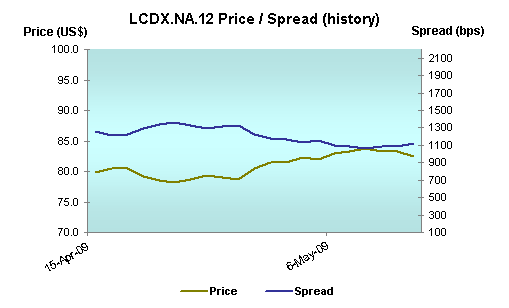
The Credit markets recovered over the few weeks particularly in the non government debt. Some of the funds that I was analyzing for investment in bank loans have moved up, some by 30%. The spread on bank loans have come down significantly from few days ago as displayed
in the chart.

There are a lot of improving signs in the credit environment:
  • LIBOR is came down and it should provide significant debt service relief
  • Mortgages are down to historic rates
  • Corporate yields are down indicating trust in corporate paper or at least some money is moving into that market.
  • even high yield rates have gone down.
  • all this is accomplished with treasuries at historic lows still, i.e. the spreads are still the same but yields have came down because people are buying and capital is flowing into the credit market rather than treasuries.

2. Commercial Real Estate Debt:
I have bought NorthStar Realty (NRF), maybe prematurely in hindsight but I still like it, to capitalize on the cheapness of commercial real estate debt.

From Bloomberg:
Top-rated commercial-mortgage bonds, which returned 32 percentage points less than Treasuries in October and November, have offered a record 12 percentage points more than government notes through Dec. 24, Barclays Capital index data show.

Debt markets are improving amid hopes that prices fell enough to account for potential defaults and as the U.S. government continues efforts to thaw credit and curb a yearlong recession. One of the AAA classes of a $7.6 billion 2007 Goldman Sachs Group Inc. commercial-mortgage-bond deal, considered a market benchmark, has jumped 24 percent, according to Ken Hackel, head of fixed-income strategy at RBS Greenwich Capital Markets.
I am considering to double down in the new year on the name; I am waiting for the possible dividend cut first. NRF will make it through this crises and will have high odds of making high returns:
  • The company has $326 million in cash while its market cap is about $250 million.
  • Its portfolio of loans are predominately prior to the 2005-2007 glut of weak underwriting and loose credit standards.
  • It has underwritten all of its loans so it has first hand knowledge of its economics.
  • Management owns 11% of the company so its interest is aligned with shareholders.
  • It has a large portfolio of health related commercial real estate which is doing strongly and values are going up.

3. Preferred Shares
I have accumulated preferred shares in Bombardier and Brookfield Asset Management to take advantage of price volatility versus the credit worthiness and strength of their balance sheets. I will add to both of these positions in the future.

I think debt have sold off more than equities and was offering equities like return with much better security in the event of default. Investors have raced to buy Treasuries for no return and it will not be long that they will seek better yields in the credit markets.

I have an equity purchase that I will make in the new year and I anticipate to be a big chunk of my portfolio. I have been studying the company for over six months and I have gotten a very comfortable feel of its competitive advantage and prospect.

Hope you have a happy new years!

November 7, 2008

NorthStar business model re-evaluation

Any lending operation currently are re-evaluating their going concern and the future of their business model. Any financing operation without a stable deposit base is at risk and have a bleak future. That's why the investment bank have disappeared from wall Street. But this change will affect many other operations depending on leverage,like leasing companies, mezzanie funds, commercial real estate reits..etc. One of my holdings NorthStar realty is one of those affected as it is a commercial financing company.

The entire sector of REITs specializing in financing commercial-property transactions are facing headwinds. Companies like NRF, Gramercy, CBRE Realty Finance Inc. and Arbor Realty Trust Inc., have seen their access to capital severely reduced by the credit crunch. They are also suffering from a dearth of property transactions and rising defaults.

The business model of traditional commercial-mortgage REITs -- which act like leveraged bond funds, making money only if the yields on their investments exceed the cost of their borrowings -- has been rendered obsolete by the credit crisis. Early this year, Gramercy bought a REIT that owns real estate to help diversify its business.

from the Wall Street Journal:

The reason: These companies have depended heavily on the ability to sell securities stuffed with the loans they originated, called collateralized debt obligations, or CDOs, in order to lock in financing for a longer period of time to match their mortgage portfolios with long-term maturities.

Today, with the CDO market all but shuttered, there is a lack of long-term debt financing that they can rely on to fund the acquisitions of assets.

"While I expect further loan impairments, the real focus will be on liquidity and any potential violation of their credit facility and bond covenants,"
NorthStar already has diversified away from the mortgage reit model into operating commercial real estate business before the credit crises. NRF has diversified into Net-lease operations through two joint ventures, Wakefield Capital, LLC, owning medical facilities and another venture, LandCap partners, with Goldman Sachs to buy distressed land rom home builders.

They have just reported their earnings and I have to say the report looked really good. Here are some highlights:
  • continue to buy back their own CDOs at 50% discount; mark-to-market works on both sides of the balance sheet.
  • The have no non performing loans (NPL).
  • Book value increased to $15 per share from $12 in Q2 2008
  • Management owns better than 10% of the company
    and is managing for the long term.
  • very good liquidity and cash position.
  • reaffirmed their dividends.
Despite an excellent report this quarter, management did indicate some
potential problems:
  • There are very uncertain loans on their watch list which very easily can become NPL; of especial significance is the WaMu tenant lease which brings over $5 million in revenue per year. JPM after taking over WaMu from the FDC has 90 days from acquisition to decide what to do with the leases.
  • NRF is accumulating cash and not doing much loan origination, which will impact future earning
  • also management said their earnings will be less if LIBOR continues to decrease which is what they expect, again hindering their net income and dividend.
I think at this point I will keep my investment in this business as the fundamentals and the reasoning that I bought NRF are still valid. NRF has a favorable chances of surviving this episode of the crises and emerging as a commercial real estate company. Yes the price have dropped significantly, and chances are it may drop further, from my cost basis but I think I will hold this one.

September 8, 2008

Fannie Mae and Freddie Mac Takeover

I am not sure  I share the optimism of the market on the takeover of Freddie Mac and Fannie Mae. The long term structural implication for the US business and banking environment is not yet clear. But here are some thoughts that come to mind:

I think BofA will be hurt in the long term as Fannie and Freddie will cut their activities by 10% a year. Countrywide Financial Corp., now part of Bank of America Corp., was the largest provider of loans purchased by Fannie Mae, accounting for 29% of its business in 2007, according to Inside Mortgage Finance, and was the second largest source of loans for Freddie Mac, with a 16% share. 

NorthStar Finance and other mortgage reits will benefit as debt spreads over treasuries will come down a lot as some uncertainties have been lifted from the market. Commercial debt and most residential mortgage debt will trade higher as their rates heads down. NRF will have a lot of business lending and making good deals and play the yield curve spread, borrowing low and lending high. 

Tax rates: personal tax rates may have to go up to fund all these bailouts. There will be some structural changes to the economy as a result of all these bailouts. What  is it? I am not  sure. But it will increase budget deficit and tax rates and that can bot be good for future earnings. 

Housing recovery may not get affected at all with this takeover. You may have Treasuries interest rates go up while mortgage rates go down and they converge some where higher, therefore not reducing the cost of borrowing much for the homeowners.

I think whatever you think of this takeover, positive or negative, it is very dangerous to decide on any long term investment or action based on this takeover and today's market reaction.

August 19, 2008

Value Idea: NorthStar Realty- part 2- Risks

Part 1 can be found here.

Investing in what is called mortgage REIT is very risky and not for the faint of heart. Mortgage REITS market caps can be cut in half within few hours, and some actually have evaporated into bankruptcy heaven, hell is more like it. So it is important to list my risks and look down rather than up on this one. Actually if you read their quarterly or annual SEC filings you will be reading 3-4 times the number of pages of any other company. So here goes:
  • Liquidity: NRF has a good liquidity profile with some $296 million in cash and liquid securities.
  • Exposure to retail: Retail commercial real estate might be a sour spot and in a weaker position compared to other CRE properties and run the risk to suffer more defaults and losses. NRF has 8% mundane exposure to this retail properties.
  • Leverage: conservative leverage running about 3:1 compared to others with leverage that reaches up to 30:1.
  • origination discipline: management is very conservative in its risk management program. They avoided all of the residential fiasco by not buying intosubprime . They also originate their own loans rather than buying on the market so their have fist hand due diligence on borrowers and most importantly in most cases they have recourse on borrowers to recover their investment, if the loans go south.
  • no delinquencies in their portfolio so far and do not expect significant delinquencies in their CRE asset backed securities (CMBS) as most of their portfolio in CMBS have been accumulated prior to 2004 avoiding aggressive lending practices in the peak of the credit bubble from 2005 to mid 2007, see distribution of theirCMBS portfolio by vintage year.
  • with respect to risks associated with their CMBS portfolio: A 15% drop in property values will do relatively little to adversely impact the credit ratings of older vintage U.S.CMBS , even those tranches that are deemed impaired, according to Fitch Ratings in a new report titled '98% of Seasoned Deals Pass Stress Tests'. Other findings from the report:
    • Fitch stress tested its rated U.S. CMBS portfolio with significant exposure to near term maturities in order to address concerns about the stability of ratings. Tests were performed on loans maturing through 2012 and the results were evaluated on each transaction tested. Fitch concluded that these older vintages inCMBS were well-insulated in the event of a sizable drop (15%) in property value. Of the 1,381 total classes stress tested, only 138 were considered 'impaired', with only 20 of those tranches at the investment grade level. By class balance, 97.8% were considered not impaired, or $74.1 billion of the $75.8 billion tested. Classes that were determined to be impaired either incurred a hypothetical loss in the stress scenario, or the resulting credit enhancement deemed too low to support the current rating.
    • How bad can it get for commercial mortgage-backed securities in the event of a recession in the U.S.? A stress test on commercial mortgage-backed securities (CMBS) in 675 CMBS bonds, finds that CMBS securities rated BB have as high as a 63% chance of downgrade in a recession scenario, according to a recent Fitch study commissioned by industry trade group, Commercial Mortgage Securities Association, so you may want take that conclusion carefully. Moving up the investment spectrum, the odds against downgrading improve. Bonds rated BBB- have only a 47% chance of downgrade, while those rated BBB face a 31% chance of downgrade. AA-rated bonds face a low 2% chance of downgrade and A-rated bonds face a 6% risk. AAA-rated bonds in the stress test showed a 2% risk of being downgraded.
    • Expected losses could reach as high as 46% in the case of BB-rated bonds and as low as 1% for A-rated bonds. In the case of BBB- bonds, expected loss is more than 17%, and investors in BBB bonds could see more than a 9% loss. HoweverNRF portfolio is investment grade only and do not have any of BBB- assets.
  • Match funding: 91% of NRF capitalization comes from long term debt the balance is from short-term credit facilities provided by JP Morgan
  • CRE market still have good fundamentals as no overbuilding occurred in this cycle, but distress in CRE will come from lack of financing. Owners have refused to sell in the last 2 quarters due to low prices but they have to sell some time if they can't refinance. My thesis is condos and single home developers will be the one doing most of the selling but income producing properties like offices and retail are in a better situation completely. Banks have been reducing commercial loans and taking reserves against commercial loans because they lump single home and condo development loans with all commercial real estate loans. Financing for this type of assets have dried up but for an owner of an office building that have a viable property will be able to get refinancing.
  • No exposure to residential or sub prime and thus they are in better shape and their portfolio did not take a big hit.
  • Retail properties exposure: Retail CRE is one of the most problematic segments in CRE with many retailers under pressure due to consumer cut back on spending. NRF exposure to this sector is a mundane 8%
  • interest rate risk: NRF earns a spread between borrowing and lending rates so if borrowing and lending rates converge earnings will vanish and the company will be under pressure.

continued credit market instability, poor visibility on commercial real estate valuations, and a continued lack of liquidity in the CRE market are all uncertainties surrounding this type of business but I will buy those risk in the face of these uncertainties.
The book value is $12.5 which give me a 43% discount from its recent trading price.

This is a position to capitalize on irrational fear of all thing real estate. According to my thesis CRE have been thrown out with the bath water.


_____________________________________________________
Sources:
http://www.reuters.com/article/ousiv/idUSN0843417620080810?sp=true
http://www.reitwrecks.com/2008/06/cmbs-prices-reflect-irrational-fears.html
http://nreionline.com/finance/investors/real_estate_catch_mezzanine_lending/
NorthStar realty presentations and SEC filings
CB Richard Ellis various research
Fitch research

August 11, 2008

Value Idea: NorthStar Realty

I have talked a lot about Commercial Real Estate (CRE) debt market in the past, see here, here, and here , and how pricing really do not reflect its economic reality. Mainstream media superficial analysis and reporting and fear from a repeat of the housing collapse have put downward pressure on all things real estate and CRE was not spared. I have also noted that CMBS debt have took a steep hair cut along with residential debt and now their pricing are attractive given their risk/ reward profile, see chart for spread over 10 year Treasuries. To be clear, I do not think this distress debt thesis will yield as a good of a result, if any, as in the previous crashes of CRE in early 1990s and 2000 downturn. There are just too many funds chasing these securities and crowding the market, keeping prices up. But still the returns can be worth while. I want to take advantage of this opportunity and place my bet, but what eluded me is how?

Then, I found NorthStar Realty Finance (NRF), the idea came thanks to reitwrecks.com. NRF is ...

... an internally managed real estate finance company that focuses primarily on
originating and acquiring commercial real estate debt, commercial real estate
securities and net lease properties. The Company conducts its operations so as
to qualify as a real estate investment trust (REIT) for federal income tax
purposes.


I bought into NRF at $8.6 on August 11 and it comes with a dividend yield of 16%, lets hope that I can see some of this yield this year!

Investment rationale:

  1. CRE Economics are OK: CMBS underlying market have relatively good fundamentals but they are priced for disaster defaults, which I do not think will happen. I have made this case before in various posts.
  2. Growth potential: I see several trends and reasons for increased business pipeline for NRF:
  • The tight credit environment offer opportunity to NRF to extend and originate loans and/ or buy discounted assets and debt. The CMBS market along with structured debt have evaporated overnight with the credit crises. It may be resurrected in the future but it won't be in the near term. Banks and traditional lenders are grasping for capital and as a result have tightened lending so much. However, there has to be a credit provider alternative for businesses and CRE and even individuals. There has to be some entity to fill the void for the market to function smoothly, albeit maybe at a higher interest rates, equity like rates of return maybe. I think private equity and companies like NRF will fill that void. It won't be cheap but I think they will price risk better than the banks did over the last 5 years. I think the growth potential here for NRF is absolutely terrific.
  • As Banks try to deleverge their balance sheets by selling loan portfolios. NRF will buy at steep discounts such portfolios and can earn high return on equity invested.
  • Another area of growth opened for NRF is sale-and-leaseback transactions, where corporations that own their offices sell them to raise capital and then lease them back from the new owners. Banks are engaging in these transaction at feverish pace; Citi bank, BofA, and many others are doing these transactions more and more. NRF has already done a number of them to Fortune 1000 corporations and will do more as corporate America tries to raise capital.
  • Mezzanine loans to owners is another growth area for NRF. Those loans provide equity like returns to originators and the dislocation in the credit markets makes the returns more attractive. Private equity outfits like KKR and Blackstone have been raising funds to take advantage of this segment, see story here. Distressed debt funds raised 38% more capital globally, raking in a total $33 billion in the first half of this year according to Private Equity Intelligence Ltd. The global pool of mezzanine capital doubled to $20 billion. The top three U.S. funds raised so far this year are: the $15 billion Warburg Pincus Private Equity X; Goldman Sachs Private Equity Group's $13 billion GS Mezzanine Partners V; and Oaktree Capital Management's $10.9 billion distressed vehicle, OCM Opportunities Fund VIIB. All this capital raising validate the thesis for NRF business model right now.
  • Liquidity is king: NRF has about $295 M in cash to deploy and in a time where liquidity is in short supply, those funds will earn excess returns. As I said above they can deploy these funds into areas of opportunities with high return on equity.
  • Experienced Management: good quality and accomplished management in the real estate and investment world. Moreover they own about 10% of outstanding shares and have been buying recently, always a good sign. NRF is internally managed that means that no asset manager is hired to mange the fund and carry the mandate. It is set up as a corporation that have employees and they make the investment decision rather an externally hired asset manager and in this case they have skin in the game through their ownership.

In the next post i will detail risks and valuation.