August 24, 2010

GLOI: Special Situations


This is a liquidation opportunity I have been following since they announce intention to sell their operating businesses. To see an overview of the opportunity, and to avoid repeating the deals, please see this post. What I will try to do here is to assess the liquidation value and answer if there is enough margin of safety to be considered a sound investment.

Valuation
Issues to consider:
  • Dilution Issues: Management (CEO and CFO) will have 516,000 shares vested and granted under their long term compensation plans due to change of control. This will dilute my ownership by 3.5%. I reckon there is no potential for other dilution issues going forward.
  • Taxes: As it stands right now there is tax issues as most sales occurred below book value. It will depend on the earn-outs amount but I think the taxes will be non issue.
  • Management Payments: There is $3,381,000 to be paid CEO and CFO for change of control clauses, bonus, and Rabbi trust in their employment agreement.
  • Real Estate leases: The company HQ is leased on month to month basis and will not pose any significant costs during the liquidation period.
  • Burn rate: I estimate that the company to have a burn rate of 2000,000 by next year end between the following components:
  • CEO/ CFO salaries: $955,000 (including bonus to CFO)
  • HQ lease: : $225,000
  • Legal fees : $200,000 (this separate from transaction fees as I netted those against the sales proceeds)
  • Other: $600,000
  • in the worst case scenario I will assume the burn rate will double to $4,000,000.
  • The holding company will be be liable for the credit line, which as of June 30, 2010 was $4.1 Million. This is offset by cash on hand of $3.8 million. Please note that in June 30 statements they have already closed on Rosetti transaction so there is $2.9 million that has already received that need to be netted out.
The following is a listing of what amounts that will flow to GLOI from the all transactions:

Please note that earn out could be higher but I based it on rolling unit revenue over the last 4 quarters.

So if we put together all items above with the best and low case estimates I can have the following potential values of liquidation:

All these buyouts are management lead buyouts. that signifies to me that the business is good and the potential of the earn outs to materialize is solid.

Risks
  • What I did not did not require any special insight or knowledge to unearth the potential. So what does the upside exist? I think the market is not discounting all the potential earn-outs. Current market value of the company is equal to the current distribution. Also I think the company is too small to be on any-one's radar.
  • CEO and CFO share sale, why? The timing of the sale came before the Bode transaction announcement. However transactions do not materialize over night. so why did management sell if the potential to earn higher value for their share down the road? I tried to research as much as possible but could not get anything. the only thing left is to get in the mind of the CEO and CFO.
  • There is no word on liquidation and how? so if management have a change of heart and decides to buy another business, then the thesis is over.
  • WC adjustments that may go against the company.
Conclusion:
A 15 months opportunity that offers a good margin of safety. I estimate that if all earnouts are not received then you will receive 10-13% return. If some earn out materialize then the potential to earn north of 20% is an outcome with high probability.

August 14, 2010

Yield Pigs

Several blogs, here, here and here, talked about the “insanity” of the bond markets. I tend to agree with the analysis. However what I am noticing is the other dimension of the insanity in the credit market is the rally in government bonds at the same time as junk and corporate bonds.

In the recovery from the March lows last year, the long term yield t-bill went up, prices went down, as money shifted from safe and liquid treasuries to other credits as they were priced attractively. Several credit classes rallied; corporate debt, junk and municipal bonds. The inverse relationship between treasuries and risky asset classes work 9 out 10 times. However, there is something amiss here.

Treasuries are rallying but at the same time so is credit. Most funds are being crowded out from some of the deals hitting the market. Spreads are coming down yet 10 yr treasuries are yielding under 2.8%. Everyone is a yield pig today ( see post about Klarman).

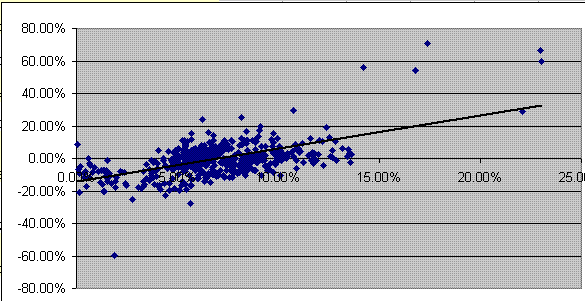
Moreover if I look at the retail investor instruments such as Closed End Funds (CEF), I find huge premiums for high distribution CEFs. High yielding CEF are trading at large premiums, sometimes reaching 40 and 50%. I put the premium along with distribution yield and got the chart below. It shows a clear relationship between yield and the premium. Investors are bidding up funds with large yields.

Actually anything with yields have rallied. The Wallstreet Journal has a story about investor appetite for Master Limited Partnership (MLP) for their out-sized yield.

I usually will bet with those buying government bonds. Government bond market is the largest and the most sophisticated in any asset class. Usually the message sent by the government yield trumps all other. However it may be different this time.

The Globe & Mail reports” ...the government bond market has been flooded by retail investors seeking what they consider a safer harbour than stocks for their investment dollars. U.S. bond funds have posted net inflows for 72 of the past 73 weeks. according to data compiled by EPFR Global of Cambridge, Mass. The bulk of that money has been earmarked for government issues, including municipal debt.”

The rally in US treasuries are perplexing given the fiscal and monetary policies of the US. Spending and loose monetary policies over extended period of time should push yields higher. The US treasury is indicating that there are no policy issues to worry about, while clearly there are many structural issues that should push yields higher, not limited to:
  • Social Security obligations
  • Health care obligations
  • Public Pension future obligation
  • State and municipal deficits and debt
The article brings an interesting conclusion: “....Baby boomers have lived through two 50 per cent market crashes and they are just leaving [equities]” in the mistaken belief they can do better in bonds.”

June 8, 2010

Opportunity in oil spill

There has been a lot of talk of the opportunity in the energy sector as a result in the sell off of the Gulf of Mexico (GOM) producers, drillers, platform operators...etc. Most of these names have been halved in price; BP is offering 10% dividend yield, which is an amazing return by itself.

The question presenting itself, is the disaster an opportunity for stock pickers? Some think it is.

The disaster is a game changer. No one can argue that in a couple of years, and into the distant future, GOM operators will operate in the same manner as they did few years back. I do not think so. Costs are going to go up materially.

Insurance, security bonds, royalties, clean up funds, taxes...etc will be on the rise as a result of this disaster. Some suggest that platform operators like SeaHawk (HAWK), which I reviewed their spin-off and did not like, is a good value proposition as it is selling below liquidating value. However it was selling below liquidation value a year ago as well.

I think the smaller the player the more disadvantaged operationally and financially in the new and expected environment. Weak balance sheets will find it harder probably to comply with bond and clean up funds requirements and will be forced out by the bigger players, who ironically caused the disaster in the first place.

If I wanted to buy, I like McDermott International (MDR), which will spin off it is off-shore construction and management business. The company operates three businesses:
  • off shore drilling project management,
  • government operation: nuclear submarine building, and
  • fossil fuel power construction

MDR will operate the off shore construction business and the spin-off will own the other two.

My idea is to buy on the spin off date MDR as it will be more than likely added to the several energy sector ETF and mutual funds. Those funds did not own it due to the complexities of the other two units and was not pure play energy equity.
  1. MDR will be less complicated than the other unit from accounting, regulation and business is easier to understand,
  2. growth potential in offshore drilling around the world; its Arabian Gulf operations is growing at a fast clip and will offset any weakness from GOM operations,
  3. demand from energy index and sector ETFs as the company will become pure play energy service company. MDR is held in mid cap portfolios but not in sector specific ETF like energy funds; ishares Energy Service, Holders (OIH)...etc. Will the spinoff induce sector specific funds to buy the oil and gas segment to be part of energy ETF/ funds? A very high possibility.
  4. The backlog of the company alone should provide good support for earnings growth.


To capitalize on the energy sell off, I will require more odds in my favour and I think MDR might do it.

May 11, 2010

CF Industries : The Perils of overpaying


I have detailed my thoughts on the Fertilizer buyout dance and how CF in its bid to stay independent overpaid. I expected the market to punish the company but the dramatic decline of CF stock exceeded my expectation. True the whole Ag space is under pressure but CF is down more than 30% compared to AGU, 12%.

This was easy short. Most of the time mergers destroy value but to overpay in such reckless fashion is a whole other story.

May 10, 2010

Value Idea: CCE implied spin off

A kind of a spin off in the works as a result of the buyout of Coke (KO) of it North American bottlers. The result of the transaction will be an independent bottler in Europe as KO will buy the NA division of CCE.

The transaction is very interesting. One thing is the transaction is not done growth. KO is buying NA bottling operation actually to limit competition in its distribution channel. The NA market is very mature and the competition is killing pricing and profitability in the system. That is why Pepsi and Coke have forked out billion to re-consolidate their own companies again. So the company being left behind is left alone not for economic issues. Actually CCE Europe is the better growth story of the two divisions.

CCE Europe or the New CCE is achieving 3% volume growth while NA coke case growth is experiencing a permanent decline. Profit growth and revenues are telling the same story. Europe is growing while NA is flat-lining at best.

So what is the valuation here?


  1. KO paid 8.4 multiple ( Entp value/ EBITDA) for NA operations
  2. the market is valuing CCE (Europe and NA) at 7.43 multiple
  3. that leaves Europe, after some backward deduction, at 6.02 multiple, that is way to cheap. Bottlers overall has an average 8.7 multiple, while other European bottlers have 9 multiple.
  4. doing some complex math the implied price per share of the new CCE will be $13.33, after $10 divined at the close of the transaction. The market may trade at $15, current price less the special dividend.
  5. If we apply peers multiples then the new CCE value is ~$19 per share. Not enough margin of safety for me at this point ( if you buy at now $26, get $10 dividends and be left with $14 to15 worth in new CCE shares, about 27% upside potential to full valuation).
However if CCE follows a typical spinoff behaviour then it might get sold off at the close of the transaction and then it may be a good value. CCE will be 100% European and it may get taken out of the S&P500 ( management “expects” to stay in the index) conditions to have fund managers dump the stock.

So at this point it is on the radar screen to see the development and price action at the close, which is expected to happen in the 4th quarter of 2010.

April 8, 2010

The Value of Corporate Events

I started to realize that hunting for value is a strategy well suited for, mostly, undervalued markets. Generally these situations appear abundant in these markets, therefore increases the odds of positive performance. However, searching for undervalued companies ala Buffett in markets that seemed to be fairly valued is not a strategy I am willing to undertake. I reckon undervalued markets like the one we had in 2008 is like shooting fish in a barrel but otherwise you need to be really a sharpshooter with strong set of skills or a lot of luck to do well.

Off course the obvious alternative is to stay on the sidelines waiting for those undervalued markets, but what if they do not materialize.

successful value investing requires significant diligence. Investing is not hard or rocket science but requires a lot of time and resources to come up with single idea. I reckon, based on my limited experience, to produce a single good idea you have to vet at least 10 with the same intensity and diligence. One of the most critical aspect of investing is generating ideas. Idea generation can't be random it has to be systematic otherwise you will never know what works. It is the pane of my investing existence is how to find those ideas? how to build a pipeline of company to analyse? do you start with A's and work down the alphabet? or do you run screens that will uncover good companies in the past? So needless to say it is important to have a "search technology", as Prof. Greenwald puts it in his book "Value Investing: from Graham to Buffett and beyond".

That is why event driven strategies is what I observed to be the best search strategy for individual investors. It is all about odds. Event driven investing puts the odds slightly in my favour. I get a concrete set of ideas with good probability of out performance. I have been concentrating on two events:
  1. Spin-offs,
  2. Post bankruptcy equity, and
  3. Index Deletion.
For example, spin-offs offer great hunting ground. I do not use spin-offs investing as a blanket approach, although I wish I did I would be better off for it. I need to vet the presence of good business and competitive advantage. Spin-offs will have duds, that's why they are being spun off. However, the odds to pick good performers over the next 3 years are much better than picking from the entire market universe. Most of the time markets fear from the uncertainty of smaller and unproven companies are wildly exaggerated.

From the spin-offs I followed, I have invested in some but not all, it out performed the S&P by 23%. That is not unusual. Most studies find 15-20% out performance for spun off companies. The reasons for the out performance vary from better focus to better information transparency.

There is a busy calender for spin-offs this year, I will post if any seem interesting.